58 high-priority audit recommendations still outstanding at Birmingham City Council, with less than one-third completed on time.
Conservatives say history of unaddressed audit warnings shows why the council must change its culture.
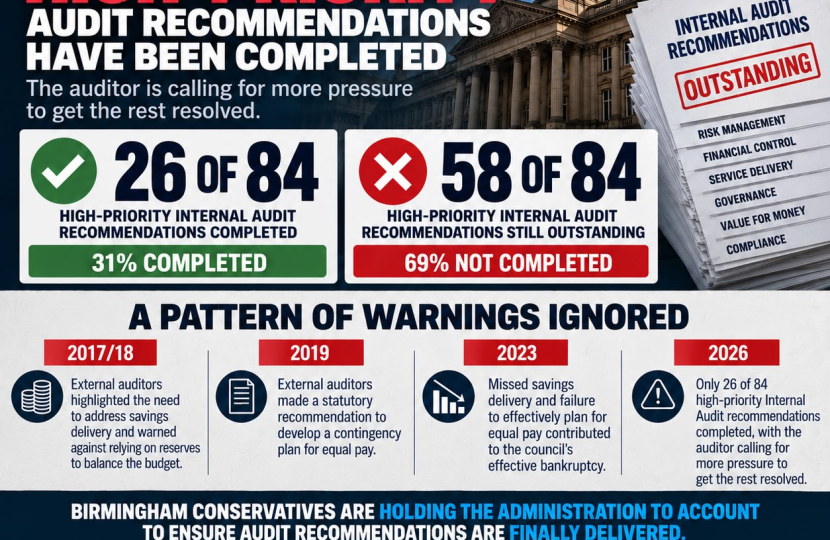
Birmingham City Council has completed just 26 of 84 high-priority Internal Audit recommendations, with the report author calling on the Audit Committee to apply greater pressure because progress is not being made.
The figures mean 58 high-priority recommendations remain incomplete covering a range of council services, including finance, social care, street scene and regeneration.
The warning comes after 14 years in which Birmingham City Council has repeatedly faced serious concerns about its governance and financial management.
Cllr Meirion Jenkins, Conservative Finance Shadow Cabinet Member and Conservative representative on the Audit Committee, said:
“These are not minor administrative actions. The report author is clear that these are high-priority recommendations, yet only 26 out of 84 have been completed. Internal Audit identifies weaknesses so they can be fixed before they become bigger problems. When 58 high-priority recommendations remain outstanding and the auditor is asking the Audit Committee to apply more pressure, we should take that extremely seriously.
Birmingham has been here before. External auditors repeatedly warned about savings delivery and financial resilience before the council issued its Section 114 notice declaring effective bankruptcy. In 2019, auditors also made a statutory recommendation calling for contingency planning around equal pay but this was never completed, allowing equal pay liabilities to balloon to unaffordable levels.
Those warnings provided opportunities to manage and mitigate risks. The question residents are entitled to ask is why so many warnings were not acted upon.”
The council’s history of audit warnings stretches back years.
External auditors made a statutory recommendation over the council’s approach to savings following the 2016/17 accounts. The following year’s accounts acknowledged the continuing risk around savings delivery and the unsustainability of repeatedly relying on reserves. Further statutory recommendations followed in 2019, including the recommendation to develop contingency planning for equal pay. Four years later, the council was facing an estimated equal-pay liability running into hundreds of millions of pounds and subsequently issued a Section 114 notice.
Cllr Robert Alden, Leader of the Birmingham Conservative Group, said:
“For more than a decade Birmingham has had reports, reviews, warnings and recommendations telling the council that things needed to change. The issue isn’t whether Birmingham City Council can identify problems. Too often, it has been whether the council actually acts after those problems have been identified.
“We saw warnings about savings before the financial crisis. We saw the recommendation for contingency planning around equal pay before the scale of that financial risk became clear. Now we are being told that more than two thirds of high-priority Internal Audit recommendations remain incomplete.
“There has to be a change in culture throughout the council. Audit recommendations cannot be treated as reports to note and then revisit months later. When auditors identify a serious risk, officers must take responsibility for addressing it and the Administration must make sure that happens. Birmingham cannot afford to keep receiving warnings and then discovering years later what happens when they aren’t acted upon.”